
MFG Foundation aids ARMC in purchasing new eye testing equipment
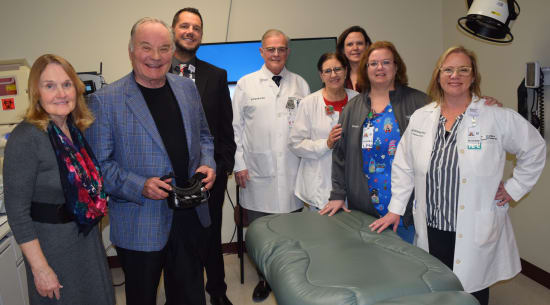 MFG Foundation recently donated funds to help purchase a new diagnostic tool which assists ARMC providers in determining the cause of a patient’s dizziness. Pictured are (from left) Audiologist Joan Kerosky; MFG Chairman of the Board Richard S. Morrison; ARMC Healthcare System President and CEO Leonard Stepp; Michael Papsidero, MD; Tina Loyd, LPN; ARMC Foundation Executive Director Amy Price; Meegan Mobley, LPN; and Cheryl Katavich, PA-C.
A donation from the MFG Foundation has helped Ashtabula Regional Medical Center replace an important diagnostic tool for determining the cause of a patient’s dizziness. The donation was matched by the ARMC Foundation to purchase a new videonystagmography (VNG) unit to replace an older unit that was no longer serviceable.
ARMC’s ear, nose, and throat providers use the VNG unit daily.
“We tested nearly 1,500 patients over the past two years,” said ARMC Otolaryngologist Michael Papsidero, MD. “The non-invasive test helps to determine if the dizziness is caused by a disorder of the ear (vestibular system) or of the central nervous system.”
With a vestibular disorder, patients may experience unsteadiness, vertigo (a spinning sensation), light-headedness, and tinnitus (ringing sound in the ears). During a VNG test, the patient wears a set of goggles which detect eye movement as the patient turns and moves their head. If a person has a vestibular disorder, they may have involuntary eye movement up and down or side to side (known as nystagmus). The VNG unit can also test a patient’s sensitivity to cool and warm air, which can help identify which ear is causing the dizziness.
If a vestibular disorder is confirmed, treatment options can include physical therapy, medication, or surgery. Physical therapy is the primary treatment choice for various balance disorders, including benign positional paroxysmal vertigo (BPPV). This is a condition in which a crystal in the inner ear breaks off from its attachments and floats in the semicircular canals. These canals are critical to balance and the movement of the otolith can cause vertigo.
The most effective initial treatment for BPPV is to perform an Epley Maneuver, in which the head is turned in a very specific manner. This will often “seat” the crystal and stop the dizziness. Such treatment can be done in the office or in physical therapy. More than 75 percent of patients presenting with BPPV respond to the Epley Maneuver after one or two treatments. Such patients may walk out of the office with none of the dizziness they experienced prior to treatment.
“Patients are amazed how much better they feel after treatment. It can be night-and-day. They may walk in feeling nauseated or like they are going to fall over because they are dizzy and they walk out with no discomfort,” Dr. Papsidero said.
ARMC Healthcare System President and CEO Leonard Stepp, Jr. said, “The MFG Foundation and Richard Morrison are committed to improving healthcare in Ashtabula County. This donation helps us to replace valuable equipment that truly makes a difference in patients’ lives every day.”
ARMC Foundation Executive Director Amy Price expressed gratitude for the long-standing support Mr. Morrison and the MFG Foundation have shown over the years. “Their commitment to helping ARMC provide quality healthcare, close to home, is unwavering. We cannot thank them enough for all the support they have given.”
Dr. Papsidero said, “You won’t find this technology everywhere. We have been using this at ARMC since 2012. It is an essential tool for our ENT practice and has helped many patients over the years.”